

The Fight Over the Door-Desk
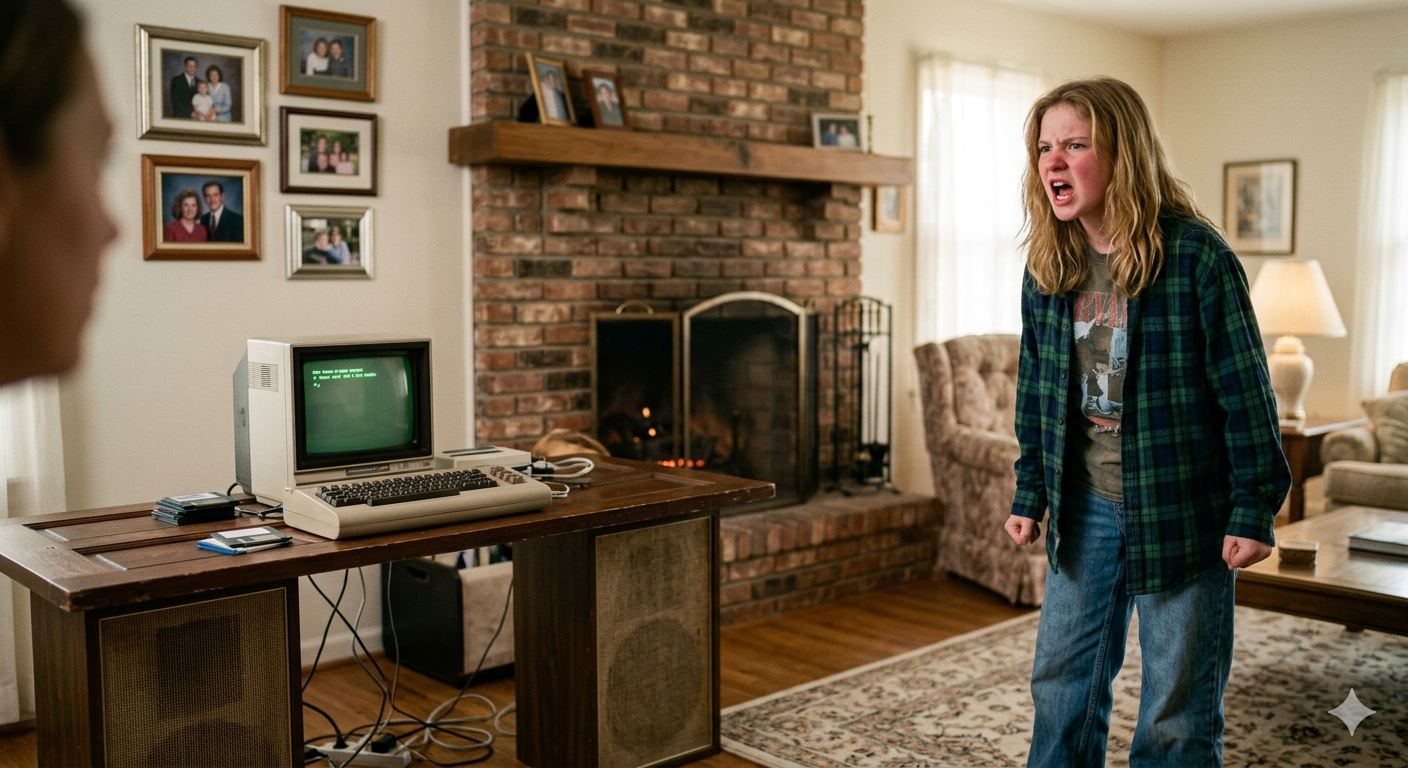
In 1994, in the middle of a fight I had no real chance of winning, I informed my mother that computers were going to ruin the world.
I was 14, which is to say I was operating on instinct rather than evidence, though the instinct turned out to be more prophetic than either of us could have known at the time. We already had a family computer by then, a Commodore 64 enthroned, somewhat absurdly, on a desk that was — and I mean this with total literalness — a door, its handle still attached and facing the window, as though it might at any moment swing open and let someone escape the room entirely. The whole apparatus was propped up on two enormous 1970s speakers, because in our house, as in most households of that era, “heavy and free” was its own kind of engineering solution. We played Reader Rabbit on it, the way children did. My mother, meanwhile, had begun typing DOS commands into a blinking black screen purely to see what would happen, and somewhere in that exploratory tinkering, something in her clicked.
(If you want the actual sound of what came next for the rest of us — the screech and hiss of a dial-up modem connecting — go ahead and play it now. It’s worth it.)
That same year she enrolled at the Chubb Institute — the technical school in New Jersey at the time, established by the Chubb insurance company because they could not find enough qualified technologists to hire and decided, with characteristic corporate pragmatism, to simply build the pipeline themselves. It has since changed hands and is now called the Anthem Institute, but in 1994 it was the place serious people went to become serious about computers. They issued her a laptop on her very first day. I remember the laptop itself, glowing on the kitchen table night after night, and her nerdy friend who would come by to talk nerdy computer talk with her for hours — a kind of conversation I had no language for yet, though I would, eventually, grow to love it every bit as much as she did. At fourteen, all I understood was that she was gone for hours during the day and consumed every evening after, and that I wanted my mother back.
So I did what furious fourteen-year-olds do — manufacture a confrontation entirely out of proportion to its cause — and somewhere in the middle of it I said something I can still recite verbatim three decades later: that computers were going to be the end of genuine human interaction. That people would shop online instead of walking into stores. That they would date online instead of meeting anyone in person. That eventually, given enough runway, nobody would need to leave the house at all.
I was only partly wrong.
“Don’t Call Me Unless Someone Has to Go to the Hospital” — A Brief Family Legend
There’s a second story from that same period that has earned permanent residence in our family mythology. My mother had a major exam looming at Chubb, and we children — being children, and being entirely unconcerned with the gravity of network administration certifications — had developed a habit of calling her constantly whenever she wasn’t home. She finally issued an edict: do not call me today, under any circumstances, unless someone requires hospitalization. Fewer than two hours later, my brother flipped his mountain bike and tore the skin clean off his inner thigh. We called, obviously. She told us to call my grandfather instead — a WWII veteran of the old, unbothered school, and close enough to get to the house faster than she could leave her exam. He arrived, surveyed the wound, pronounced “that’s nothing,” wrapped it himself, and sent everyone back outside to resume whatever they’d been doing. My brother did, in fact, require stitches once my mother finished her test, got home, and got a proper look at it herself. She has never lived this down. To this day, she knocks on wood before she leaves the house for anything important.
I REALLY Didn’t Know I Was Signing Up For
What I didn’t understand at fourteen was that I had just sketched, however crudely, the outline of the next thirty years. What I understood even less was that I was about to spend most of those thirty years embedded inside the very machine I’d been railing against.
My mother completed that program and built an entire career on the back of it — recruited by IBM shortly after, then running global networking for Levitz Furniture, then for Proudfoot Consulting, until a car accident forced her into disability retirement when I was in my late twenties. I followed her into that same school years later, studying programming and web development from 2000 to 2001, right as the internet I’d predicted with such adolescent fury was finally beginning to resemble the internet I’d predicted.
From there I spent more than fifteen years working alongside businesses that serve people with disabilities, and that is where I actually watched the future assemble itself, piece by deliberate piece, long before anyone had the audacity to call it artificial intelligence.
I saw optical character recognition machines the size of washing machines, built for people who were blind, priced well beyond what most households could justify. I watched early text-to-speech software that sounded like a dying robot reading a ransom note, sold almost exclusively to schools and clinics because no consumer market would have tolerated either the price or the performance. I watched environmental control units — the devices that let someone with limited mobility turn on a light, change the channel, or unlock a door without anyone’s help — run around $6,000 apiece, and that price didn’t even include the installer you had to hire by the hour to come wire it into your home. I was working in accessibility tech in November 2014 when Amazon announced the Echo and Alexa, and I remember thinking how strange it was that “voice activated” suddenly meant something for everyone, in every living room, when for years it had only meant something for the small, underserved population who’d needed it desperately and paid dearly for it. I watched language translation tools that required, quite literally, a government contract to access. And I watched the iPad — a consumer tablet nobody designed with disability in mind — quietly displace augmentative and alternative communication devices that had cost families $6,000 to $8,000 apiece, the kind of dedicated speech-generating hardware that people like Stephen Hawking relied on for decades, suddenly available to a child with cerebral palsy or apraxia for the price of a tablet and an app. Every single one of these technologies began as something specialized, prohibitively expensive, and engineered for people the open market had no financial incentive to serve affordably. And then, gradually and almost invisibly, each one became free. Ambient. The sort of thing you stop noticing because it has simply taken up residence in your phone.
Inside the Machine Room
After that I spent three years in partner marketing at AWS, which let me observe the other half of the equation: the infrastructure itself. I watched tool after tool get stacked on top of the last, layer accumulating on layer, until “the cloud” stopped meaning any single company’s product and instead came to describe a tangle of interdependencies between AWS, Microsoft, Google, and Cloudflare that almost nobody actually using any of it fully comprehends. You needn’t search far for evidence of how precarious this arrangement actually is. In July 2024, a single flawed CrowdStrike update grounded airlines, disrupted hospitals, and froze banks within the same afternoon — because everything is now standing on everything else, and very few people outside the room understand exactly how thin that foundation has become.
So when people inform me, with great urgency, that AI is coming whether I like it or not, I find I don’t require much convincing. I have watched this precise pattern — specialized and expensive, then suddenly free and ubiquitous — play out across the entirety of my adult life, observed from three distinct vantage points: as a consumer, as an accessibility advocate, and as an infrastructure insider. None of those perspectives made AI feel any less inevitable. What they did instead was make me considerably harder to impress, and considerably more interested in how something is built and who profits from its construction, than in whether or not it’s arriving.
The Things I Used to Know
None of that is what actually worries me, though. What worries me is smaller and quieter than infrastructure or inevitability — it’s what AI might be doing to my brain while I’m busy being unimpressed by everything else.
A few months ago I came across an article in Time examining what AI might be doing to the way students think and learn, and it landed somewhere I hadn’t anticipated. It called to mind something far smaller and far more personal: I used to know phone numbers. Dozens of them, committed entirely to memory. I had to — there was a Yellow Pages on the kitchen counter and a phone bolted to the wall clear across the room, and if you intended to call someone, you ran the length of the house repeating seven digits to yourself the entire way, lest they evaporate from your mind before you arrived. That particular muscle no longer exists in me. I can recite perhaps four phone numbers from memory now, my own included. The skill didn’t vanish because I became less capable. It vanished because I stopped exercising it, because something else quietly assumed the responsibility on my behalf.
That, I think, is the real question lurking beneath all of this for me. Not “will AI eliminate jobs” or “will AI eventually govern the world.” Something smaller and closer to home: if I allow AI to do the entirety of my thinking, will my capacity to think eventually atrophy the same way my memory for phone numbers already has?
I don’t believe the answer is avoidance. I attempted something like that with smartphones for roughly four years, and the principal result was chronic lateness. The answer, as far as I’ve worked out, is to engage with it deliberately — the way one might use a muscle on purpose, rather than simply allowing the muscle to be used.
AI Is My New Fidget Toy for the Brain
So that is what I’ve begun doing. I’ve taken to calling AI a “fidget toy for my brain” — a tool that allows me to indulge the parts of my ADD mind that I once had to suppress, apologize for, or quietly fight into submission, and instead lets them run freely toward something productive. In recent months alone, I’ve used it to construct a chart unpacking what “left,” “right,” “Democrat,” and “Republican” actually signify beneath the slogans we’ve all absorbed without examination. I compared quality-of-life and education metrics across the countries everyone references constantly and almost nobody actually verifies. I processed an entire tax return from start to finish, purely to determine whether I could (please regard this as entertainment rather than legal counsel). I designed a team of Pixar-style mascots modeled on my own family for a marketing venture. I researched market size and sourcing strategy for a business idea I may very well never launch. I rewrote my own résumé four separate ways before landing on the version that actually sounded like me.
None of this constitutes productivity in any conventional sense. It is, mostly, play. But it is the particular variety of play that leaves something behind afterward — a sharper question, a clearer thought, something I genuinely did not know before I began.
Full Circle, New Loop
Here is what makes me laugh, sitting here three decades later. The fourteen-year-old who screamed at her mother about computers destroying the world, and the woman who has since worked inside accessibility technology and AWS and now writes about artificial intelligence for a living — we actually agree with each other. We are both excited. We are both suspicious. Neither of us trusts any of this blindly, and neither of us believes for a moment that it’s going anywhere.
I have spent three decades drawing closer and closer to the machine — accumulating access, expertise, an insider’s understanding of precisely how the sausage gets made — and somehow it has deposited me right back where I began: selective. Careful about where I spend my money, deliberate about who receives my data, and entirely convinced that the ethics of the people building these tools matter every bit as much as what the tools themselves are capable of doing.
But here’s the difference between then and now. With the internet, I got the whole story thirty years after the fact — I’m sitting here doing the retrospective, connecting the dots only after they’d already been drawn. I don’t want to do that again. I don’t want to wake up in 2056 writing the AI version of this same article, marveling at what I apparently called correctly while everyone else missed it.
So this column isn’t going to be a thirty-years-later retrospective. It’s going to be the play-by-play — written as it happens, not after. I’m going to document this in real time: the experiments, the mistakes, the moments AI genuinely makes me sharper and the moments it tries to make me lazier, the ethical lines I draw and redraw as the technology moves faster than the conversation about it. Bias charts and tax returns and Pixar mascots are just the beginning. I have a lot of questions, and this time, I’m asking them while it’s still happening instead of waiting three decades to figure out I already knew the answer.
That, fundamentally, is what this column is. Not a guided tour of how powerful AI has become. A running account of one Xennial’s deliberate experiment in using it on purpose — to expand, rather than to simply coast — told from inside the moment, not from the safety of hindsight. Come along, if you’d like. I have a lot of questions, and apparently I’ve had them since I was fourteen.
If any of this gave you a nostalgic itch, the Computer History Museum in Mountain View, California has entire exhibits dedicated to machines exactly like my family’s Commodore 64 — worth a visit if you’re ever out that way.